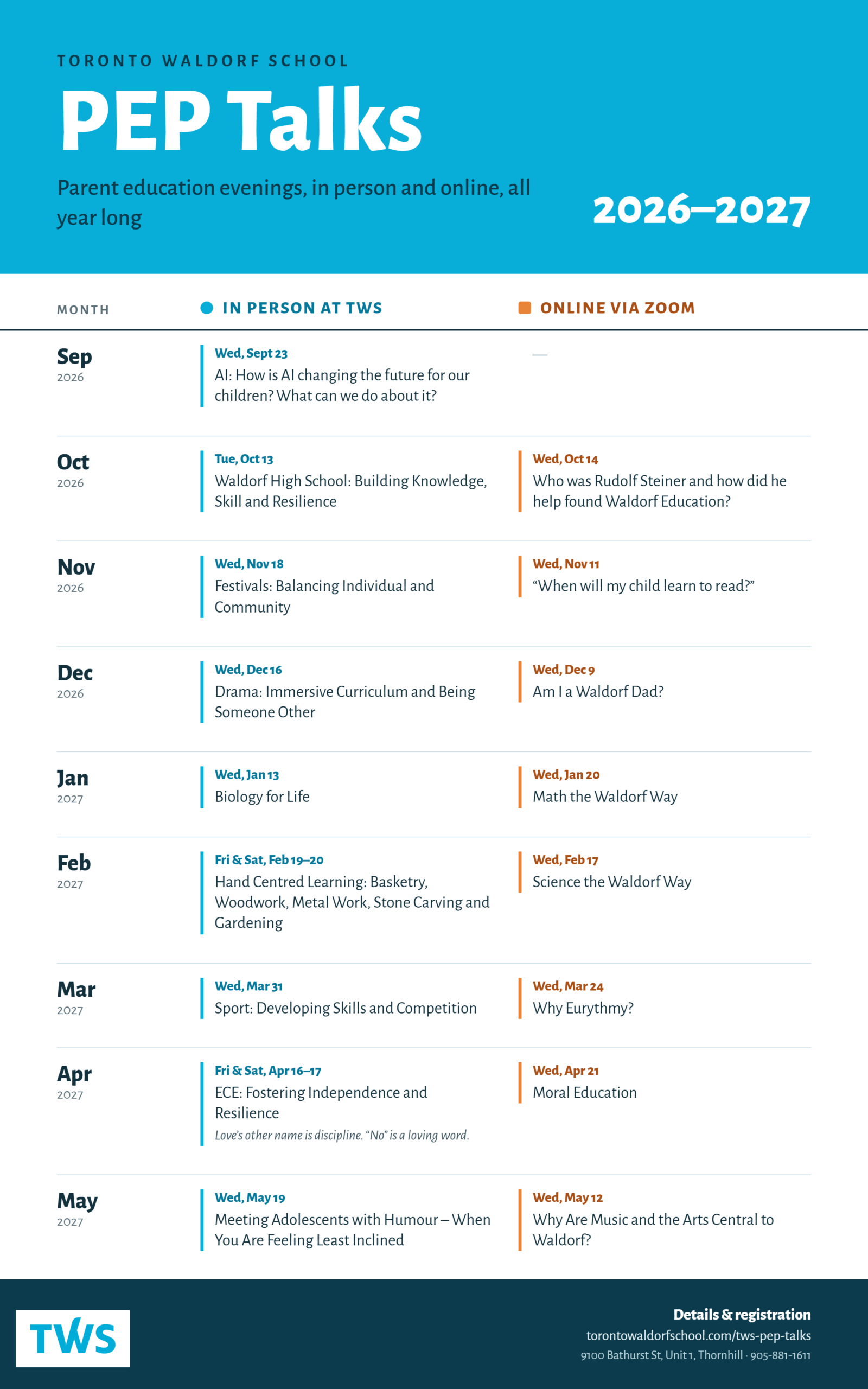
October 13, 7pm-9pm
Waldorf High School: Building Knowledge, Skills, and Resilience
Join us for an evening of insights into the genius of Waldorf High School, the true flowering of Waldorf education. Learn how TWS brings living education to life for adolescents. This special evening will be presented by author and TWS alumnus, Alessandro Tersigni along with the TWS High School Faculty. It is an event not to be missed.
Register here: Waldorf High School: Building Knowledge, Skills, and Resilience
Online PEPtalks via Zoom are led by Warren Lee Cohen M.Ed.
Warren taught two classes of Waldorf students through Grade 8. He has also taught Waldorf teachers from around the world. He was the director of Waldorf Teacher Education at RSCC, founded the Summer Festival of Arts and Education, and directed Foundation Studies in Anthroposophy in England. His latest book is Celebrate Passover, preceded by The Waldorf Book of Blessings, Raising the Soul, and Baking Bread with Children. He is a warm and engaging educator.
Wednesday October 14
Who was Rudolf Steiner and how did he help found Waldorf Education?

Waldorf education was born at a time of international crisis. Out of the ashes of WWI Rudolf Steiner and a team of teachers set out to create a school to support factory workers’ children. This new impulse in education was designed to be comprehensive, holistic, and a school worthy of imitation. The first free Waldorf school has since given rise to more than 1,200 Waldorf schools in 80 countries around the world.
Wednesday November 11
“When will my child learn to read?”
The Waldorf approach to learning to read is rigorous, engaging, fun, and time tested. Young students are immersed in language rich environments filled with story, song, poetry, movement and meaning. Teachers provide living examples of people who love language and craft meaning with their words. The skills for learning to read are steadily built each year in meaningful and developmentally appropriate ways so that students become life-long-learners.
Wednesday December 9
Am I a Waldorf Dad?
Finding our feet as fathers is no small task in our times. There are countless pressures, expectations, dreams and fantasies with which we all measure our successes and judge our shortcomings. Where do we look for good examples of how to be a good father? What tools do we have to guide us? We’ll explore these themes in presentation and conversation.
Wednesday January 20
Math the Waldorf Way
Mathematics is filled with rhythm, beauty, and meaning. In the early grades we sing and stomp multiplication tables. We draw beautiful images connected with the numbers and processes. Math stories reveal deeper levels of truthfulness. In the middle grades, these images turn into formulas and loftier concepts. In high school, math and philosophy merge. It is a rigorous journey.
Wednesday February 17
Science the Waldorf Way
Children are eager to understand the world around them. They naturally want to use all their senses to learn and grow into adults who are capable of imparting meaning and purpose to their lives. At TWS we place a high value on learning through experience, in doing, observing, reflecting, questioning and finally to reaching understanding. Science classes are rigorous, engaging, hands-on experiences where observation and questioning are paramount to building knowledge.
Wednesday March 24
Why Eurythmy?
Eurythmy is a new artform created in parallel with Waldorf Education. Through choreographed movements eurythmy makes speech and music visible. It reveals the inner life of sound and how it touches our cores. It helps children coordinate their own movements while learning to work with others. Come explore why eurythmy is at the heart of Waldorf education.
Wednesday April 21
Moral Education
How can we best educate children to develop clear and dependable moral compasses to guide them through life? This is a dance between form and freedom. If we only indoctrinate children with our own morals, they may follow our dictates but will not have the opportunity to sharpen their own insights. If we neglect to give them clear examples or boundaries, they may well range dangerously far afield. How can we navigate this tension to achieve balance?
Wednesday May 12
Why are Music and the arts central to Waldorf?
The arts are the gateway to the soul. Children will gladly draw the same picture or sing a beloved song time and again. It nourishes them deeply. It lives in them. Waldorf education harnesses children’s innate love of the arts to deepen their engagement with the curriculum and to nourish their souls with beauty.